
Passenger Dash Airbag
Quick Reference Links
Passenger Dash Airbag
Passenger Side Airbag:
The passenger airbag is located underneath or is part of the passenger dashboard. Older models are usually single-stage and newer models are dual-stage. Although most earlier passenger airbags included the cover there are many new variations where the airbag is underneath the dash and is not sold with the cover.
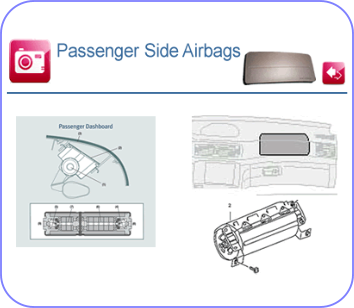
Passenger Airbag Types
Passenger Airbag Styles:
The passenger airbag comes in many styles. The single stage version can be identified by a single connector with two wires. The dual stage passenger airbag has four wires leading to one connector. Some airbags come with the cover attached and others that don't are called inner-bags.
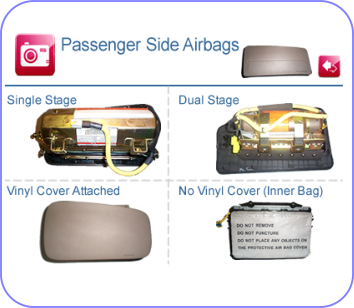
Passenger Airbags Saves Lives
Passenger-side air bags reduce the overall fatality risk of car passengers age 13 and older by a statistically significant 13.5 percent. It is estimated that an additional 88 right front passengers ages 13 and older would have died from 1986 to 1995 if passenger cars or light trucks had not been equipped with passenger-side air bags. To date only one passenger, a 98-year-old female, has died as the result of an adult passenger-side airbag related injury.
Do Passenger Airbags Pose a Risk For Children
Passengers: Properly restrained adults sitting back in the seat are not at significant risk from an inflating airbag, but there is a risk for children and infants in the same position. Children are safest when properly restrained in rear seats. Rear-facing infant seats should never be placed in the front passenger seat with an airbag. Infants with medical conditions that require constant observation may need to ride in the front, and then an passenger airbag switch would be needed. If a driver transports too many children to put them all in back seats, an older child may ride up front with the seat all the way back and the child secured in a lap/shoulder belt sitting back in the seat. If a driver does get a switch, it should be used to turn off the passenger airbag only when an infant or child must ride in front. It should be noted that vehicles without rear seats are required to have an on/off switch installed for the passenger airbag; this includes some pickup trucks and some small cars.
The Future of Passenger Airbags
The future is advanced airbags. Most new models have redesigned airbags, and future airbag technologies will reduce the risk even among people who have moved forward before airbags inflate. Sensors will detect rear-facing restraints and automatically switch off passenger bags. Inflation rates will be tailored to crash severity. More advanced airbags could recognize people’s positions just before inflating and reduce the force if someone is in position to be harmed.
Passenger Airbags and Occupant Position
The position is what counts, serious inflation injuries occur primarily because of people’s positions when airbags first begin inflating. Anyone, regardless of size or age, who’s on top of, or very close to, an airbag is at risk. Most airbag deaths have involved people who weren’t using belts, were using them incorrectly or were positioned improperly. People without belts or using them incorrectly, especially passengers, are at risk because they’re likely to move forward during hard braking or other violent maneuvers before crashes. Then they’re likely to be very close to, or on top of, airbags before inflation begins. Improperly positioned people at risk include drivers who sit very close to the steering wheel — 10 inches or closer — and infants in rear-facing restraints in front seats. Understanding that airbag injury risk is related to position leads to a few simple steps that can eliminate the risks without sacrificing airbag benefits.